

Built to meet the standards regulators are setting and the quality patients deserve
Leading global regulators recognize AI’s potential to accelerate safe, effective drug development across the product life cycle, but require sponsors to establish AI model credibility through a risk-based framework: defining the model’s role, assessing its risk, and demonstrating transparency, data reliability, and ongoing performance monitoring throughout the product’s life cycle.
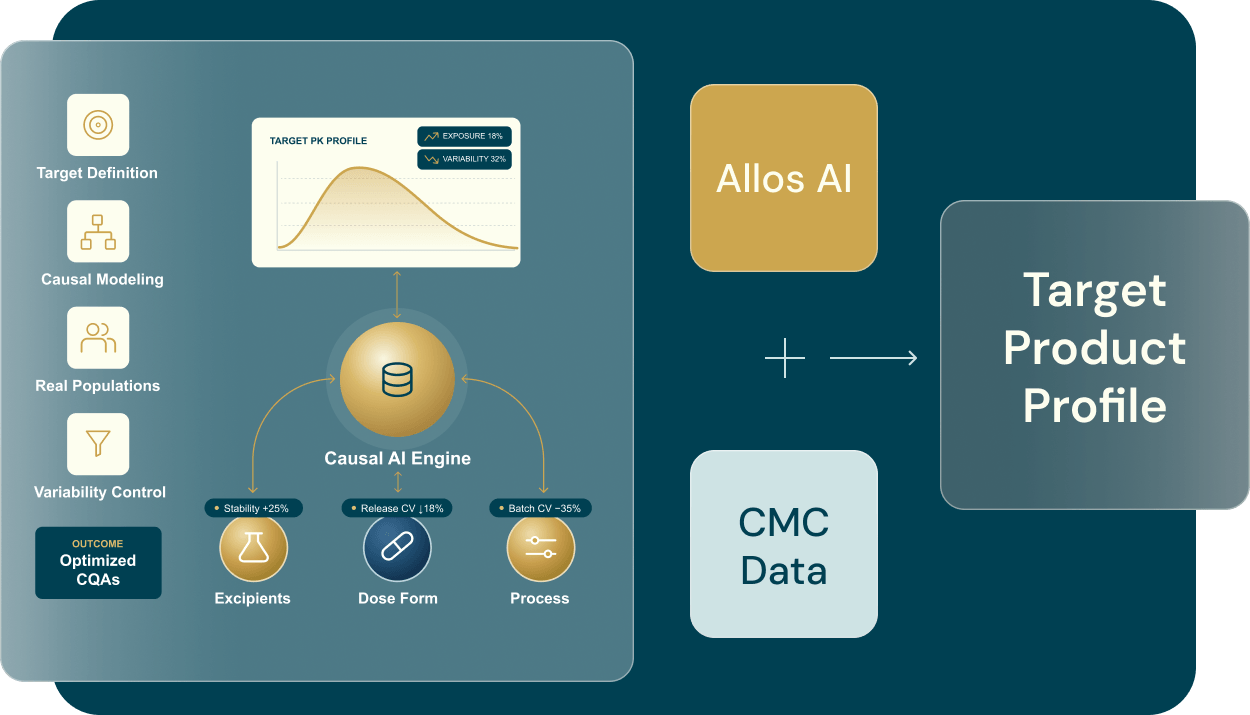
Allos’s causal AI is built for exactly these standards. Every model output traces to an explainable causal graph, not a black-box prediction, giving sponsors the transparency, traceability, and defensible evidence regulators require, so formulation decisions hold up to scrutiny from day one.
Quality at every step, from the AI model to finished formulation
Every Allos formulation program is built on a foundation of quality, not just speed. The platform is paired with a pharmaceutical team that has collectively filed over a thousand molecules, ensuring every AI-directed decision is grounded in real regulatory and manufacturing experience. Formulations are developed through a network of vetted CDMO partners operating to cGMP standards, with full data traceability from experiment to outcome. The result is a formulation process built to withstand regulatory scrutiny and, ultimately, deliver reliable, high-quality medicines to the patients who depend on them.
Continuous quality improvement
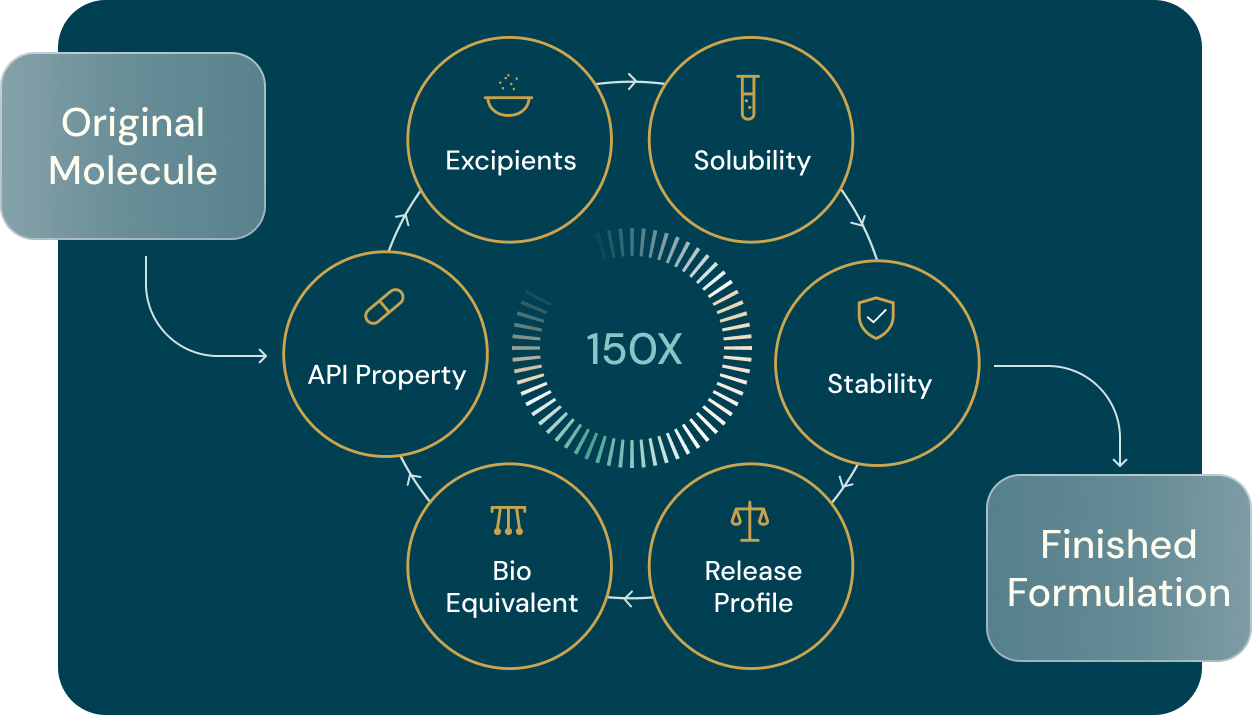
While Allos’s causal AI platform reduces the number of experiments required by 60%, on average, data from every experiment feeds directly back into the model, sharpening its accuracy with each program. Built on a foundation of thousands of formulation experiments across many molecules, this data flywheel means the platform’s capabilities only strengthen over time.
Built for compliance with leading global regulators
Regulators, including the FDA, EMA, MHRA, and others, require AI models used in drug development to demonstrate credibility through a risk-based framework. Sponsors must define the model’s role and risk level, then show that its data is relevant, reliable, and traceable, and that its outputs are transparent enough to withstand scrutiny. Black-box models struggle here, since they can’t explain why a particular decision was made.
However, Allos’s causal AI is built for this standard. Every recommendation traces back through an explainable causal graph, giving sponsors and regulators a documented rationale behind every formulation decision, not just a prediction to take on faith.


Flexibility across regulatory pathways
Allos can support programs through either a bioequivalence study or a full clinical trial pathway, depending on what the formulation change and program overall require. The platform adapts to the regulatory route being pursued rather than forcing a program into one path.
Experts-in-the-Loop
When AI outputs directly determine a regulatory decision, global regulators call for evaluating the performance of the human-AI team together, not the model alone. While humans-in-the-loop are required, Allos has experts-in-the-loop to assess every drug development decision. Our team has collectively filed over a thousand molecules, with decades of experience spanning formulation development, CMC, regulatory affairs, and manufacturing across major markets.
Traceable
Explainable
Flexibile
Success Story: Oral Solid Dose Bioequivalence Rescue
challenge
An oral solid dose was challenged by its dissolution profile, releasing nearly twice as fast as the reference at early time points, threatening Cmax and putting bioequivalence at risk. The client needed to know whether faster dissolution would actually shift human PK before committing to an expensive bioequivalence study.
approach
Allos modeled the dissolution curves using a causal hierarchical model, then connected dissolution to PK through a semi-mechanistic absorption model calibrated to the reference drug. Simulations produced predicted GMR distributions and passing probabilities under fasted and fed conditions, accounting for GI physiology and formulation variability.
outcome
We optimized the study design, testing crossover versus replicate designs, sample size, and early sampling schedules to maximize the probability of passing on both Cmax and AUC. The client moved forward with a study designed around real risk, not assumptions.
The Allos causal AI platform delivers solutions
From patent cliffs to failed bioequivalence studies to molecules with no formulation precedent, Allos's causal AI platform offers solutions for challenges across the drug development lifecycle.


Quality and regulatory FAQs
-
Yes, FDA, EMA and other leading regulators explicitly recognize AI's growing role in drug development, including manufacturing and formulation. FDA's draft guidance names facilitating the selection of manufacturing conditions as a specific example use case, while EMA confirms AI in process design, optimization, and batch release is expected to increase. Both require documenting the model's role, data, and performance and assessing them against a risk-based framework before its outputs support a regulatory decision.
-
Agencies favor transparent, explainable models over black-box ones. EMA states plainly that transparent models are preferred, and black-box models are acceptable only when developers can prove transparent alternatives underperform. FDA similarly flags that complex, non-transparent models can make it difficult to understand how conclusions were reached. A model that can explain its own reasoning, like causal AI, faces a more direct path through review.
-
Both FDA and EMA require that training and test data be relevant, reliable, and fully traceable, meaning the data must represent the target population or manufacturing process and be accurate, complete, and documented from source to outcome. EMA further requires documentation of how data was collected, cleaned, and processed in line with GxP requirements. Undocumented or unrepresentative data undermines a model's regulatory credibility, regardless of its predictive accuracy.
-
Yes. Both agencies require life cycle monitoring because AI model performance can drift over time or across environments as new data is introduced. FDA calls for risk-based monitoring tied to a manufacturer's pharmaceutical quality system, while EMA requires defined performance thresholds and mechanisms to detect degradation, including protocols for suspending or decommissioning a model if its performance falls out of bounds.
-
Generally, yes, particularly for high-risk applications. FDA's guidance calls for evaluating the performance of the human-AI team together when a "human in the loop" is part of the context of use. EMA lists human agency and oversight as a core ethical principle across the entire medicinal product lifecycle, and requires a system risk management plan whenever a model operates without direct human review.