
When a formulation is failing, fast answers are everything
Bioequivalence is falling short, a stability failure occurred, or a formulation isn’t withstanding the rigors of scaling to commercial volumes. Formulations at risk require difficult and often urgent decisions–invest more time and capital or abandon the asset. Traditional root-cause analysis is slow and often inconclusive, and every week spent deciding is a week the drug isn’t generating revenue, or a competitor is closing the gap. We put our AI modeling to work to quickly rescue troubled formulation projects.
Root-cause answers from AI modeling coupled with the expertise of pharmaceutical leaders
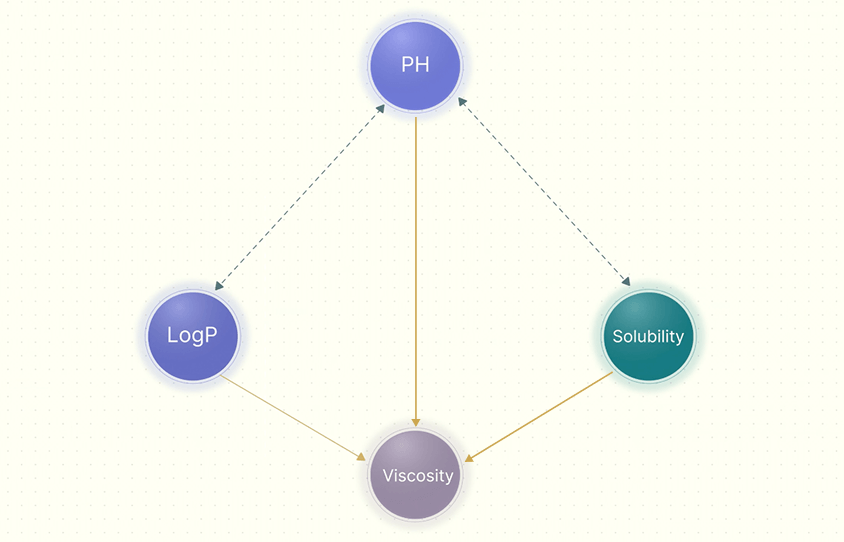
When a formulation fails, the instinct is often to re-run the same battery of experiments and hope for a different result. Allos takes a different approach. We use our causal AI platform to build a mechanistic graph across the variables behind your formulation, tracing failure back to its actual cause rather than a proxy that merely correlates with it. That distinction is often the difference between a rescue and a repeated failure.
60%
Fewer experiments
40%
Shorter timelines
$6–15M
Costs saved
2,000
Formulation experiments conducted
Our modeling work is paired with a pharmaceutical team that has collectively filed over a thousand molecules, so every finding is stress-tested against real development experience before it shapes a decision. Together, our advanced technology and experienced pharma experts give developers fast, defensible answers.
The Allos formulation rescue workflow
-
01 Formulation Rescue IntakeMore Detail
Allos reviews the existing formulation, process, and study data, including the specific problems, to understand exactly where and how the program broke down.
-
02 Build the Causal ModelMore Detail
Allos's causal AI platform maps the formulation, process, and analytical variables behind the failure into a mechanistic graph, distinguishing the variables that actually drove the outcome from those that merely correlated with it.
-
03 Identify the True Root CauseMore Detail
The model traces the failure back to its actual driver, whether that's a mis-ranking assay, an overlooked process variable, or a formulation choice that looked promising but predicted the wrong outcome, and explains why.
-
04 Deliver a Go/No-Go RecommendationMore Detail
Allos presents the root-cause finding alongside a clear recommendation including what a realistic path to success looks like, so the pharmaceutical development team can decide with evidence rather than guesswork.
-
05 Direct, Efficient RemediationMore Detail
If the program moves forward, Allos's platform prioritizes the specific experiments needed to resolve the root cause, avoiding the broad re-screening that extends timelines without addressing the actual problem.
-
06 Validate the FixMore Detail
Partner CDMOs or the program owner execute the targeted experiments, and results feed back into the model to confirm the fix holds before the program advances further.
-
07 Resume the Path ForwardMore Detail
With the root cause resolved, Allos compiles the updated chemistry, manufacturing, and controls package needed to carry the rescued formulation through to clinical or commercial-scale production
One partner from modeling to manufacturing
Every Allos engagement is tailored to your program’s specific needs, but the core approach stays the same.
Advanced causal AI technology
works to solve your formulation challenge, modeling the chemistry and directing experimentation toward what matters most
Our technologists
build the models and manage the data behind every program
Our pharmaceutical veterans
source and manage the right CROs and CDMOs to execute wet lab testing and manufacturing
How the Allos causal AI platform guides workflows
Formulation rescue FAQs
-
Allos works with programs that have hit a genuine wall, like a failed or borderline bioequivalence study, a stability failure, a formulation that won't scale to commercial manufacturing, or a candidate that looked promising in screening but failed in vivo. If the program has real data from a failed attempt, whether from internal work or a CDMO, Allos's causal AI can use that data to find what went wrong.
-
Re-running the same battery of experiments tends to produce the same result, because it doesn't address why the formulation failed in the first place. Allos builds a causal model of the formulation, process, and analytical variables involved, which distinguishes the actual driver of failure from variables that only appeared related. That distinction directs new experimentation at the real problem instead of repeating a broad, unfocused screen.
-
Most rescue engagements deliver an initial root-cause finding and a go/no-go recommendation within 8 weeks of onboarding. This timeline gives portfolio teams a fast, evidence-based answer on whether to invest further in remediation or reallocate capital to a different asset, without spending months re-running experiments that may not address the underlying issue.
-
This happens more often than teams expect. In past programs, Allos has traced failures back to a mis-ranking in vitro release method rather than the formulation, or to a manufacturing process variable like hold time that sat outside the original formulation design space. Because the causal model spans formulation, process, and analytical variables, it can catch root causes that a formulation-only review would miss.
-
Yes, and these are among the cases where causal modeling adds the most value. Repeated bioequivalence failures usually mean the team has been optimizing against the wrong variable, a proxy rather than the true cause. Allos's platform re-examines the full data set from prior attempts to identify what drove the miss, then directs a smaller, targeted set of experiments at the corrected root cause.