
Why causal AI is different, and why it matters for drug development
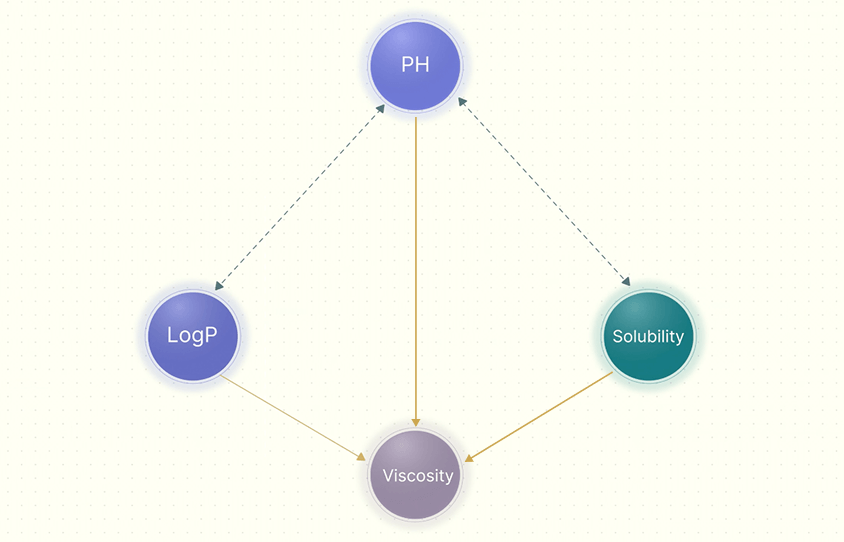
Causal AI brings a different kind of intelligence to drug development. Rather than simply predicting what may happen next or autonomously taking action, it models cause-and-effect relationships to show why an outcome occurs and what is likely to change when a variable is adjusted. For formulation development, where chemistry, process conditions, pharmacokinetics, and clinical performance are deeply interconnected, that ability helps teams make faster, more informed, and more transparent decisions.
The Allos difference starts with causal AI
Many of us have become increasingly familiar with generative AI platforms like ChatGPT, Claude, Gemini, and others. But generative AI is only one part of a much broader AI landscape. Predictive, causal, and agentic AI each solve different types of problems, from forecasting outcomes to understanding cause and effect to taking action toward defined goals. Causal AI, the foundation of Allos’s causal AI drug development platform, is especially powerful because it helps teams understand why outcomes occur and how changing one variable may influence another.
Causal AI
Models cause-and-effect relationships to explain why outcomes occur and predict what may happen when specific variables change. In drug development, this enables teams to explore complex interactions, test counterfactual scenarios, and make transparent, evidence-backed decisions before experimentation begins.
Pros
- Identifies cause-and-effect relationships, not just correlations
- Shows how changing one variable may influence another
- Produces transparent, traceable reasoning behind recommendations
Cons
- Requires careful model design and high-quality domain inputs
- Can be more complex to build and validate than purely predictive models
Predictive AI
Analyzes historical data to identify patterns and estimate what is likely to happen next. In drug development, it can forecast outcomes, rank candidates, and support decision-making by learning statistical relationships across formulation, process, biological, and performance data.
Pros
- Can process large datasets quickly
- Identifies useful patterns to improve forecasting
- Helps teams prioritize promising candidates or variables for further investigation
Cons
- Identifies correlations, not necessarily causes
- Coincidental relationships can mislead it
- May struggle to explain why it made a prediction.
- Generally requires very large data sets drug developers typically do not have
Agentic AI
Goes beyond analysis to take actions toward a defined goal. It can plan tasks, make decisions, use tools, and adapt its next steps based on results, allowing systems to automate complex, multi-step workflows with limited human intervention.
Pros
- Automates repetitive or complex workflows
- Coordinates multiple tasks
- Responds dynamically as new information becomes available
Cons
- Can reduce transparency and human control
- May act on poor assumptions or flawed inputs
- Can take inappropriate or unintended actions if not properly governed
Generative AI
Creates new content, such as text, images, code, or summaries, by learning patterns from large datasets. It is especially useful for communication and interaction, allowing users to generate, organize, and interpret information through natural-language prompts.
Pros
- Creates text, images, code, and other content quickly
- Makes complex information easier to summarize and communicate
- Enables intuitive interaction through natural-language prompts
Cons
- Can generate inaccurate or fabricated information
- Does not inherently understand cause and effect
- Outputs depend heavily on training data, prompts, and human review
Built for compliance with leading global regulators
Regulators, including the FDA, EMA, MHRA, and others, are embracing the efficiency and quality improvement AI technology can provide. However, they require AI models used in drug development to demonstrate credibility through a risk-based framework.
One partner from modeling to manufacturing
Every Allos engagement is tailored to your program’s specific needs, but the core approach stays the same.
Advanced causal AI technology
works to solve your formulation challenge, modeling the chemistry and directing experimentation toward what matters most
Our technologists
build the models and manage the data behind every program
Our pharmaceutical veterans
source and manage the right CROs and CDMOs to execute wet lab testing and manufacturing
One platform de-risks diverse formulation programs
From patent cliffs to failed bioequivalence studies to molecules with no formulation precedent, Allos's causal AI platform addresses formulation challenges at every stage of the drug development lifecycle.