
Turning early-stage data into a formulation roadmap
Traditional new chemical entity (NCE) formulation means testing batches, reviewing results, adjusting variables, and repeating the cycle many times, with too many interdependent variables and too little reusable learning between rounds. The Allos team uses our causal AI platform to generate explainable formulation pathways, works with the small datasets typical of early-stage molecules, and stays transparent rather than a black box, using limited data as it is generated. The result is a highly optimized drug formulation map, rather than an iterative, failure-prone process.
AI modeling and experienced pharmaceutical leaders deliver NCE formulation success
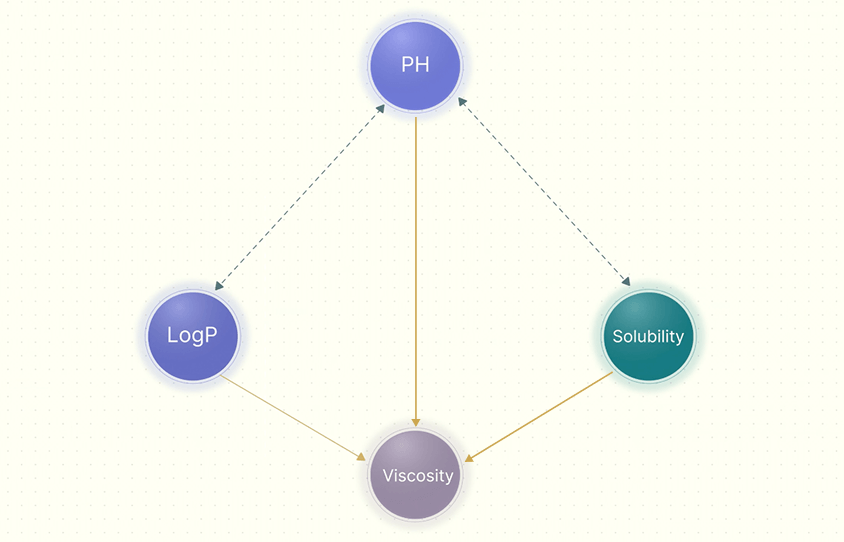
A new chemical entity comes with no established success and is often just a limited number of early data points, conditions where traditional screening approaches struggle most. Allos's causal AI platform builds a mechanistic model from the available data, mapping how formulation, process, and biological variables interact to determine a formulation's effectiveness. Because the model is transparent rather than a black box, your team can trace every conclusion back to the evidence behind it and challenge it.
60% Fewer
experiments
40% Shorter
timelines
$6–15M Costs
saved
2,000
Formulation experiments conducted
That modeling is paired with pharmaceutical leaders who have collectively filed over a thousand molecules across formulation science, CMC, and regulatory strategy. Together, they turn a molecule with no formulation precedent into a defined, evidence-backed path forward.
The Allos new chemical entity formulation workflow
-
01 Available Data IntakeMore Detail
Allos ingests everything already known about the molecule, including in vitro assays, preclinical PK, biomarker data, and target and mechanism information, even when the data set is small.
-
02 Build the Causal ModelMore Detail
Allos's causal AI platform builds a mechanistic graph over the molecule's chemistry, biology, and delivery constraints, learning from limited early-stage data rather than requiring the large datasets traditional screening depends on.
-
03 Directed, Efficient ExperimentationMore Detail
Rather than screening broadly across every formulation variable, Allos's platform prioritizes the experiments most likely to confirm or challenge the proposed delivery pathway, so early-stage resources go toward the questions that matter most.
-
04 Select the Right CDMO PartnerMore Detail
Based on the modeled formulation requirements and delivery route, Allos selects the best-fit CDMO partner from its network of dozens worldwide to execute the work.
-
05 Run and Refine the ExperimentsMore Detail
Partner CDMOs execute the experiments the model calls for. Results feed back into the platform, sharpening the model with each iteration as more data on the molecule becomes available.
-
06 Validate the FormulationMore Detail
Allos guides the program through the studies needed to support first-in-human trials, adjusting the formulation and delivery strategy as real data comes in.
-
07 Deliver the Manufacturing PackageMore Detail
Allos compiles the complete chemistry, manufacturing, and controls package needed to move the NCE from formulation into clinical-stage production, with a single point of contact throughout.
One partner from modeling to manufacturing
Every Allos engagement is tailored to your program’s specific needs, but the core approach stays the same.
Advanced causal AI technology
works to solve your formulation challenge, modeling the chemistry and directing experimentation toward what matters most
Our technologists
build the models and manage the data behind every program
Our pharmaceutical veterans
source and manage the right CROs and CDMOs to execute wet lab testing and manufacturing
How the Allos causal AI platform guides workflows
Success Story: Diagnosing a hidden bioequivalence failure
challenge
A dry powder inhaler prototype passed every standard bench test, yet failed in the clinic. Only 21% of doses reached adequate early exposure, and weak, low-flow inhalers were most affected. Six rounds of conventional troubleshooting all plateaued near the same failing result.
approach
Allos modeled the causal system, running a multi-flow diagnostic across the flow range patients actually generate rather than the single flow used in standard bench testing. This revealed that total particle size distribution looked identical at high flow but collapsed at low flow, exposing the real driver behind the failure.
outcome
A variability decomposition showed patient inspiratory flow, not formulation noise, drove 55% of the exposure variability. This causal reframe reversed months of testing that had chased the wrong lever and pointed the team to the formulation change that worked.
New chemical entity FAQs
-
Yes. Allos's causal AI is built to work with the small, early-stage datasets typical of NCEs, including in vitro assays, preclinical PK, and target and mechanism data, rather than requiring the large datasets traditional formulation screening depends on. The model builds a mechanistic picture of the molecule from what is already known and refines it as new data is generated.
-
Allos is a causal AI platform that uses a sponsor's own proprietary data, including CMC data and the Target Product Profile, to optimize a formulation. Allos builds a program-specific causal graph around the molecule's actual chemistry and development goals, which allows it to prioritize the experiments most likely to move the program forward.
-
Allos's platform models how the molecule's chemistry and biology interact with different delivery routes, whether an immediate-release tablet, an injectable, a nasal spray, or another modality, to identify which route is capable of delivering an effective dose. This matters most for molecules with a narrow therapeutic window or a systemic exposure time too short for certain delivery routes to work, where the wrong choice can waste months before the problem surfaces.
-
Black-box AI models can flag a promising formulation without explaining why, which is a real liability when there's no formulation precedent to pressure test the result. Allos's causal AI is a glass-box model in that every prediction traces to a specific variable and relationship a formulator can examine and challenge. For a molecule with no track record, that traceability often gives a team the confidence to move forward.
-
By directing experimentation at the variables most likely to determine whether a delivery route will work, rather than screening broadly across every formulation variable, Allos's approach typically cuts required experiments by roughly 60% and shortens development timelines by about 40% compared to conventional methods. For an NCE program, that difference often determines how quickly a candidate can reach first-in-human trials.