
A new way to turn mature molecules into market opportunity
While patent expiration sharply reduces a drug’s revenue-generating potential, many pharmaceutical companies underresource lifecycle extension work, prioritizing resources for new drug development. However, reformulating, creating a new dosage form, and/or designing a new drug delivery route, and filing a 505(b)(2) NDA can restart exclusivity, extending a molecule’s commercial life for years. The challenge is which assets are worth pursuing, which formulation strategies have the highest probability of success, and how to move quickly enough to capture the opportunity before the window closes.
AI-directed reformulation coupled with decades of pharmaceutical development experience
The Allos team uses AI modeling to direct reformulation campaigns, mapping every viable reformulation strategy, pointing to the options most likely to succeed and why. Our technology is not only extremely effective for reformulating a specific asset, but also for portfolio analysis, helping determine which assets offer the best opportunity to exchange portfolio value.
60%
Fewer experiments
40%
Shorter timelines
$6–15M
Costs saved
2,000
Formulation experiments conducted
AI modeling cuts the guesswork pharma teams face when determining the viability of a reformulation effort, or when a program stalls or falters.
Allos leverages its powerful technology and the experience of our seasoned pharmaceutical executives. This allows us to partner across the full scope of the effort, including drawing on a network of dozens of CDMO partners worldwide to execute chemistry, manufacturing, and control efforts and, ultimately, manufacturing of clinical and commercial drug products.
The Allos reformulation workflow
-
01 Identify the OpportunityMore Detail
To identify the best reformulation opportunities, Allos screens patient data, prescribing patterns, and portfolio inputs to flag molecules where a reformulation would solve an unmet need and would result in a profitable reformulation effort. Consideration factors often include pending loss of patent protection, as well as poor patient adherence, dosing difficulties, and suboptimal bioavailability.
-
02 Determine the Reformulation StrategyMore Detail
Allos’s causal AI platform maps every viable formulation route for the molecule, including options such as tablet to liquid, injectable to long-acting injectable, oral to nasal spray, and beyond. The platform identifies the most likely path to succeed, and why, before any lab work begins.
-
03 Directed, Efficient ExperimentationMore Detail
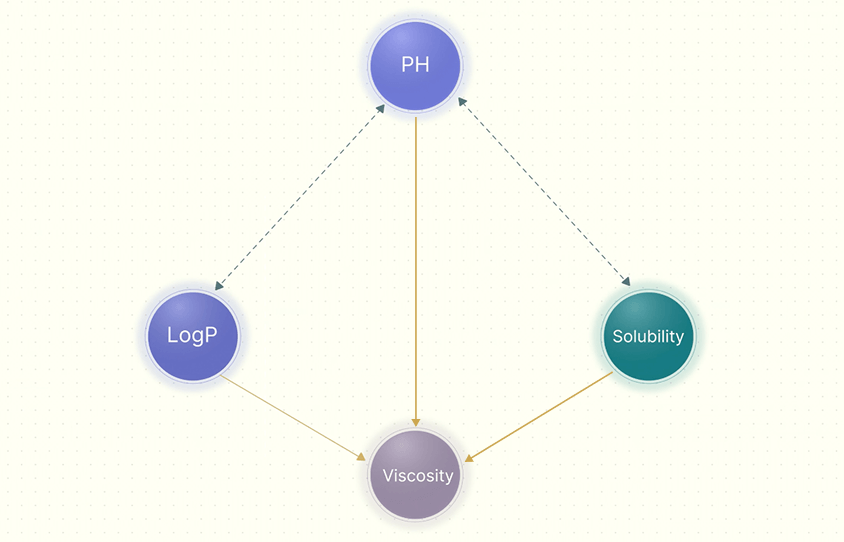
Reformulation means managing many interacting factors, like API and excipient properties, solubility, stability, viscosity, release profiles, bioequivalence and manufacturing processes. Traditional workflows run 150+ experiments, with too many variables and little reusable learning, so programs take too long and require too many resources. Allos AI modeling, paired with CMC data and the TPP, maps the route and cuts required experiments by 60% on average.
-
04 Select the Right CDMO PartnerMore Detail
Allos matches each program with the best-fit CDMO based on formulation requirements, manufacturing capabilities, geographic considerations, regulatory pathway, and commercial objectives. Our global network provides access to dozens of specialized CDMO partners without requiring clients to manage multiple providers themselves.
-
05 Run and Refine the ExperimentsMore Detail
The partner CDMO executes the experiments the model calls for. Results feed back into the Allos platform, sharpening the model with every iteration, a data flywheel built on nearly 2,000 prior formulation experiments.
-
06 Validate the FormulationMore Detail
Allos can guide the program through bioequivalence studies or a full clinical trial pathway, adjusting the formulation based on real results as they come in.
-
07 Manufacturing ExecutionMore Detail
Allos coordinates the chemistry, manufacturing, and controls (CMC) package required to advance the formulation toward clinical and commercial-scale production. Clients benefit from a single point of accountability across formulation development, CDMO execution, and manufacturing, reducing coordination complexity while maintaining continuity from development through commercialization.
One partner from modeling to manufacturing
Every Allos engagement is tailored to your program’s specific needs, but the core approach stays the same.
Advanced causal AI technology
works to solve your formulation challenge, modeling the chemistry and directing experimentation toward what matters most
Our technologists
build the models and manage the data behind every program
Our pharmaceutical veterans
source and manage the right CROs and CDMOs to execute wet lab testing and manufacturing
How the Allos causal AI platform guides workflows
Success Story: AI-driven stabilization of an oral Liquid
challenge
An oral liquid formulation faced three compounding risks: oxidative degradation from lipid excipients causing API impurities, physical instability from phase separation and temperature-sensitive viscosity, and a preservative system undermined by the high pH needed to protect the API.
approach
Allos flagged high-risk unsaturated oils and peroxide-forming surfactants driving oxidation, and recommended low-peroxide excipient sourcing, antioxidant addition, and oxygen-controlled packaging. It identified the preservative’s reduced effectiveness at high pH and proposed a dual-preservative strategy alongside polymeric stabilizers and optimized homogenization to prevent phase separation.
outcome
The client moved forward with a formulation strategy addressing all three instability risks before committing to stability studies, backed by a validated preservative system and a dosing-consistent physical formulation, avoiding the late-stage surprises that typically surface only after batches are made.
Drug lifecycle management FAQs
-
Reformulation involves testing batches, reviewing results, adjusting variables, and repeating the cycle many times across factors like API properties, excipients, solubility, stability, release profile, and bioequivalence. These variables are highly interdependent, and traditional programs generate little reusable learning between iterations, so teams often run well over 150 experiments before landing on a viable formulation.
-
Yes. Allos operates within an ISO 27001-aligned security framework and is compliant with both HIPAA and GDPR. Proprietary CMC data and Target Product Profile inputs are used only to build and refine the causal model for your specific program, giving you the benefit of AI-optimized formulation without compromising data governance or confidentiality standards your organization requires.
-
Any approved molecule where a new dosage form, delivery route, or formulation could meaningfully improve patient care or restart exclusivity. Common examples include converting an injectable to an oral tablet, a tablet to a liquid or nasal spray, or an immediate-release drug to a long-acting depot. Allos looks for molecules with a clear unmet need, often signaled by patients requiring more frequent dosing, combination therapy, or difficulty with the existing form.
-
The 505(b)(2) pathway lets a sponsor rely in part on FDA's prior findings for an already-approved drug, making it well suited to new formulations, dosage forms, or delivery routes of existing molecules. Allos's causal AI maps the formulation and bridging strategy needed to support this pathway, helping identify which changes require a full clinical package versus a more limited bridging study, which can shorten timelines and reduce the data burden.
-
Programs typically onboard in about 4 weeks and produce initial results in around 8 weeks, letting a team decide quickly whether to move forward. From there, timelines depend on the formulation type and regulatory pathway, but Allos's modeling consistently cuts required experiments by roughly 60% and shortens overall development timelines by about 40% compared to conventional approaches.