
Turning formulation guesswork into a defined path forward
Traditional drug formulation is trial and error. Teams test batches, review results, adjust variables, and repeat the cycle many times, often more than 150 experiments per program, with too many interdependent variables and too little reusable learning between rounds.
Allos takes a different approach. Our team uses our causal AI platform to model formulation chemistry, mapping which variables drive success and why before lab work begins. The result is faster formulation development that withstands regulatory scrutiny.
How Allos de-risks drug formulation
Allos's AI modeling directs reformulation campaigns, mapping viable reformulation strategies, pointing to the options most likely to succeed and why. Our technology is not only extremely effective for reformulating a specific asset, but also for portfolio analysis, helping determine which assets offer the best opportunity to exchange portfolio value.
60%
Fewer experiments
40%
Shorter timelines
$6-15M
Costs saved
2,000
Formulation experiments conducted
Humans-in-the-loop are critical for effective use of AI technologies, but Allos goes far beyond that requirement. Our team has collectively filed over a thousand molecules, with decades of experience spanning formulation development, CMC, regulatory affairs, and manufacturing across major markets.
One partner from modeling to manufacturing
Every Allos engagement is tailored to your program’s specific needs, but the core approach stays the same.
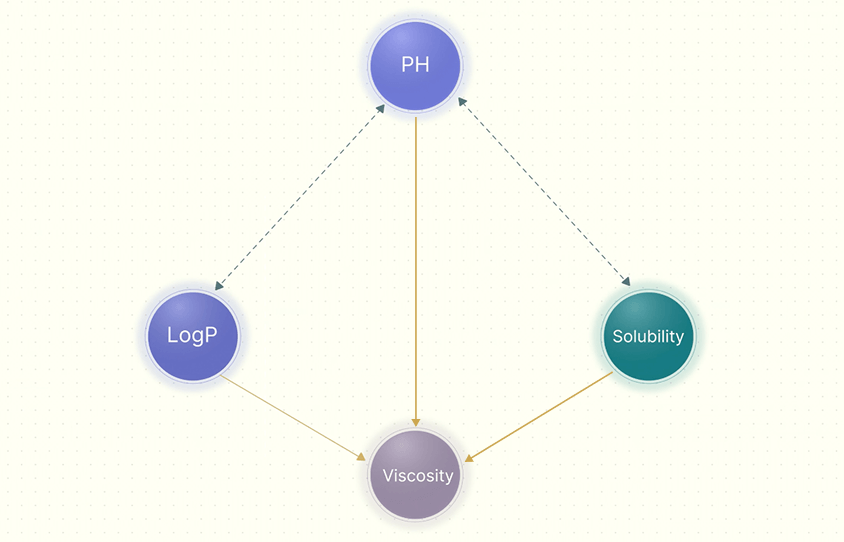
Advanced causal AI technology
works to solve your formulation challenge, modeling the chemistry and directing experimentation toward what matters most
Our technologists
build the models and manage the data behind every program
Our pharmaceutical veterans
source and manage the right CROs and CDMOs to execute wet lab testing and manufacturing
Formulation Path Optimization Avoids Trial and Error Iteration
We take Drug Formulation from an Iterative, Failure-prone Process to a Highly Optimized Map
How the Allos causal AI platform guides workflows
Success Story: Diagnosing a hidden bioequivalence failure
challenge
A dry powder inhaler prototype passed every standard bench test, yet failed in the clinic. Only 21% of doses reached adequate early exposure, and weak, low-flow inhalers were most affected. Six rounds of conventional troubleshooting all plateaued near the same failing result.
approach
Allos modeled the causal system, running a multi-flow diagnostic across the flow range patients actually generate rather than the single flow used in standard bench testing. This revealed that total particle size distribution looked identical at high flow but collapsed at low flow, exposing the real driver behind the failure.
outcome
A variability decomposition showed patient inspiratory flow, not formulation noise, drove 55% of the exposure variability. This causal reframe reversed months of testing that had chased the wrong lever and pointed the team to the formulation change that worked.
One platform de-risks diverse formulation programs
From patent cliffs to failed bioequivalence studies to molecules with no formulation precedent, Allos's causal AI platform addresses formulation challenges at every stage of the drug development lifecycle.


De-risking drug formulation FAQs
-
Allos is a causal AI platform that uses a sponsor's own proprietary data, including CMC data and the Target Product Profile, to optimize a formulation. Allos builds a program-specific causal graph around the molecule's actual chemistry and development goals, which allows it to prioritize the experiments most likely to move the program forward.
-
Allos works across the full range of formulation challenges, including extending the life of a molecule facing patent expiration, developing complex generics that are difficult to formulate and prove bioequivalent, rescuing programs after a failed study, and mapping delivery pathways for new chemical entities with no formulation precedent. Whatever the starting point, the same causal AI platform models the chemistry, identifies the drivers of success, and directs experimentation toward the path most likely to work.
-
Most AI used in pharma today identifies correlations, patterns that look meaningful but don't explain cause and effect. Allos uses causal AI, which models why a variable drives an outcome, not just that it's associated with one. That distinction lets the platform direct experimentation toward what actually matters and explain its reasoning in a way regulators and formulators alike can evaluate and trust.
-
On average, Allos's platform reduces required experiments by roughly 60% and shortens development timelines by about 40% compared to conventional formulation approaches. The exact impact depends on the molecule and the complexity of the formulation challenge, but the underlying principle holds across programs: directing experimentation toward the variables that actually matter cuts out the wasted iteration that drives up both cost and time.
-
Generally, a traditional CDMO scopes work around the equipment and processes it already has. Allos's causal AI platform models the formulation chemistry and route of delivery first, independent of any one facility's capabilities, then matches the project to the right partner from a network of 50+ CDMOs worldwide. That means the formulation strategy is chosen on the science, not on a single CDMO's capabilities.