

We reduce complex generics formulation complexity risks, accelerating the path to filing
Complex generics are often attractive therapeutic assets, but formulation challenges are frequently the barrier to market. For example, drug products such as long-acting injectables, nasal sprays, transdermals, and other dosage forms are difficult to replicate and demonstrate bioequivalence to the reference product. Allos manages the multitude of formulation variables, helping avoid failed bioequivalence studies that can cost months and send a program back to the drawing board. We’re here to help.
AI modeling and experienced pharmaceutical leaders together solve bioequivalence challenges
The success of complex generics hinges on bioequivalence (BE), and the variables that determine BE success, like particle size distribution, viscosity, release kinetics, injection-site behavior, and more, interact in ways that standard screening processes often can't efficiently identify. Allos's causal AI models these interactions, identifying which variables drive bioequivalence outcomes so formulation teams can prioritize the experiments that matter most.
60%
Fewer experiments
40%
Shorter timelines
$6–15M
Costs saved
2,000
Formulation experiments conducted
Effective AI-driven drug development only works when it's grounded in experience. Allos pairs its causal AI platform with pharmaceutical leaders who have collectively filed over a thousand molecules with expertise in formulation science, CMC, and regulatory strategy. They guide every program, translating what the model finds into a formulation and filing strategy built to withstand FDA review.
The Allos reformulation workflow
-
01 Identify the OpportunityMore Detail
Allos screens the reference product's formulation, dosage form, and delivery route to flag where replication is genuinely difficult, and where that difficulty creates real advantage. Consideration factors often include complex delivery mechanisms like long-acting injectables or nasal sprays, demanding bioequivalence requirements, and a favorable first-to-file window still open in the market.
-
02 Determine the Reformulation StrategyMore Detail
Allos’s causal AI platform maps every viable formulation route for the molecule, including options such as tablet to liquid, injectable to long-acting injectable, oral to nasal spray, and beyond. The platform identifies the most likely path to succeed, and why, before any lab work begins.
-
03 Directed, Efficient ExperimentationMore Detail
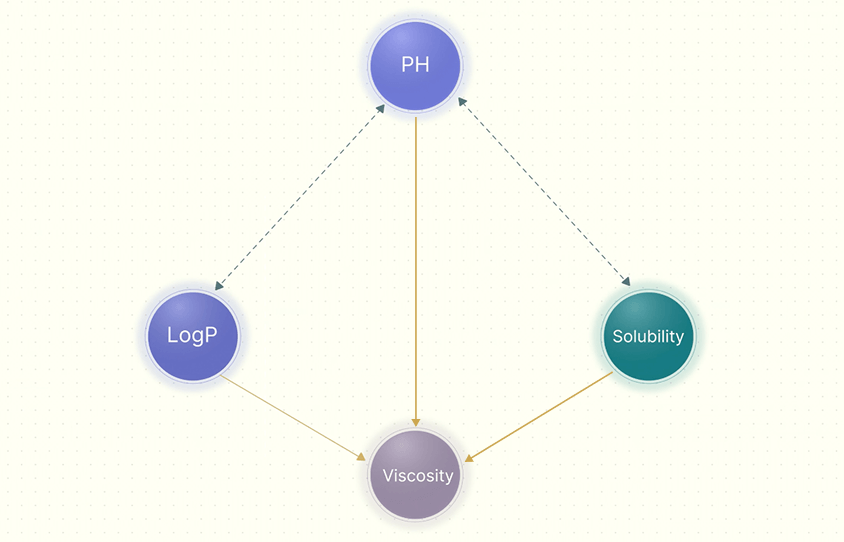
Matching a complex generic to its reference product means managing many interacting factors: API and excipient properties, solubility, stability, viscosity, release profiles, and bioequivalence criteria. Traditional workflows run 150+ experiments, with too many variables and little reusable learning, so programs take too long and risk a failed BE study. Allos AI modeling, paired with CMC data and the TPP, maps the route and cuts required experiments by 60% on average.
-
04 Select the Right CDMO PartnerMore Detail
Based on formulation requirements, manufacturing capabilities, geographic considerations, and regulatory strategy, Allos selects the best-fit CDMO partner from its global network of specialized providers.
-
05 Run and Refine the ExperimentsMore Detail
The partner CDMO executes the experiments the model calls for. Results feed back into the Allos platform, sharpening the model with every iteration, a data flywheel built on nearly 2,000 prior formulation experiments.
-
06 Validate the FormulationMore Detail
Allos can guide the program through bioequivalence studies or a full clinical trial pathway, adjusting the formulation based on real results as they come in.
-
07 Manufacturing ExecutionMore Detail
Allos compiles the complete chemistry, manufacturing, and controls package needed for clinical and commercial-scale production. Our clients benefit from a single point of accountability across formulation development, CDMO execution, and manufacturing, reducing complexity and maintaining continuity from development through commercialization.
How the Allos causal AI platform guides workflows
One partner from modeling to manufacturing
Every Allos engagement is tailored to your program’s specific needs, but the core approach stays the same.
Advanced causal AI technology
works to solve your formulation challenge, modeling the chemistry and directing experimentation toward what matters most
Our technologists
build the models and manage the data behind every program
Our pharmaceutical veterans
source and manage the right CROs and CDMOs to execute wet lab testing and manufacturing
Success Story: Cracking a bioequivalence barrier on a complex injectable
challenge
A long-acting complex generic injectable program failed its first animal readout on three fronts: first-week burst releasing 25-30% of the dose, week-12 exposure 42% below the efficacy threshold, and a palpable depot in 5 of 8 animals. The original path forward called for 120+ experiments to resolve it.
approach
Allos built a causal graph across roughly 40 variables to find the true drivers behind the failure. The model demoted particle size as a false lead, pointed to particle size distribution span and surface state instead, rebuilt the misleading release assay, and rejected the best-releasing candidate because it predicted a persistent nodule.
outcome
In nine months, the program moved from a 5 mL intramuscular injection to a 1.2 mL subcutaneous formulation. First-week burst dropped to under 10%, palpable depots fell to 1 of 8 animals, and the clinical path shifted to a single enriched study, using 38 experiments instead of the 120+ planned.
Complex generics FAQs
-
Complex generics involve difficult formulations, dosage forms, or delivery routes, like long-acting injectables, nasal sprays, or transdermals, where the underlying chemistry may be well understood but proving bioequivalence to the reference product is challenging. FDA regularly issues product-specific guidances for these products outlining its current thinking on the studies and information needed to support approval of a safe, effective generic. That difficulty is also the opportunity in that complex generics face far less competition than standard oral solids, which sustains pricing and rewards the teams that solve the formulation problem first.
-
Most complex generics are filed as ANDAs under the 505(j) pathway, which covers complex dosage forms, formulations, and delivery routes, though some fall under 505(b)(2) depending on the extent of formulation change relative to the reference product, as FDA's guidance on determining whether to submit an ANDA or a 505(b)(2) application outlines. Allos models the formulation early to help clarify which pathway a given program is likely to require.
-
Standard generics typically require demonstrating a straightforward pharmacokinetic bioequivalence in a small clinical study. Complex generics involve many more interacting variables, like particle size distribution, viscosity, release kinetics, and injection-site behavior, that all influence whether the product is truly bioequivalent. Traditional screening approaches test these variables largely in isolation, often running 150+ experiments with limited reusable learning between them, which is why complex generic programs take longer and cost more than standard ANDA filings. Allos AI modeling drastically reduces the experiments required and the resulting timeline.
-
Rather than screening broadly, Allos's causal AI models identify which variables actually drive bioequivalence for a given dosage form, distinguishing root causes from variables that only appear correlated. That distinction matters because chasing the wrong variable, like optimizing median particle size instead of particle size distribution span, can pass early screening and still fail bioequivalence later, extending a program’s timeline by months.
-
Speed matters most when a formulation window is open, and competitors are racing toward the same reference product. Allos's platform typically cuts required experiments by 60% on average by directing lab work toward the variables most likely to determine success, and its network of dozens of CDMO partners worldwide means execution can start without delay.